From Following Instructions to Building Systems That Respond
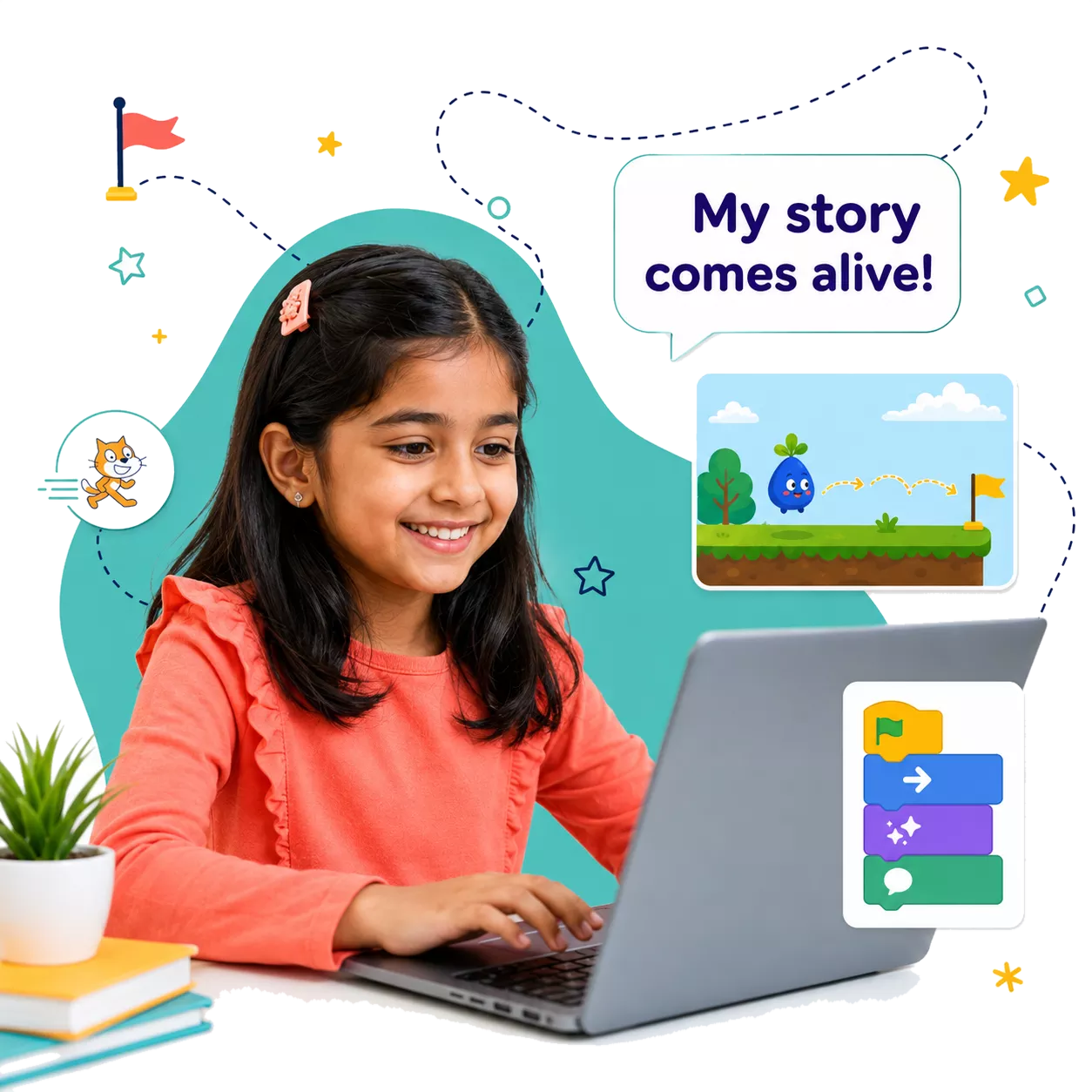
Give your child their next serious step in creative technical work. In small groups, with skilled mentors, children move from arranging instructions to building sprites and simple games that respond to what they do - leaving every session with something that runs, and one decision they made and can explain.
At Circuit, children take everything they learned physically at Spark and meet it again on screen a repeat block is now the dance move they already know, a variable is the labelled box they already swapped the contents of. The shift that defines this level is the first "if/then": for the first time, a project responds to something the child didn't directly command. We do not teach syntax in isolation or hand children a finished game to copy every project is built from a decision they make and can justify.
A 24-week progression that takes kids from foundational coding concepts to building, testing, and confidently presenting an original project of their own.
Weeks 1–8
Sprites, Sequence & Repeat
Sprites & Characters
Advanced Sequences
Predicting Outcomes
Introduction to Loops
Repeat Blocks
Breaking Projects into Smaller Parts
Independent Project Building
Weeks 9–16
Rules That Respond
Introduction to If/Then Rules
Events & User Input
Click & Key Press Interactions
Collision-Based Actions
Simple Scoring Systems
Reusing Code
Interactive Games & Scenes
Weeks 17–19
Craft & Feedback
Finding & Fixing Bugs
Explaining Design Choices
Giving & Receiving Feedback
Helping & Collaborating with Peers
Introduction to Online Safety
Safe & Unsafe Information Sharing
Weeks 20–24
The Capstone Project
Independent Project Planning
Building an Original Interactive Project
Using Responsive Rules
Testing & Debugging
Improving the Project
Explaining Decisions & Bug Fixes
Project Presentation
What They Explore
The Six Powers.
1
Chop It (Decomposition)
Naming three to four parts of a project, alone.
Spot It (Pattern Recognition)
Spotting repeated code and replacing it with a loop.
2
3
Zoom Out (Abstraction)
Explaining what a block does, without listing every detail inside it.
Step It (Algorithmic Thinking)
Ordering ten or more steps and predicting the outcome before running it.
4
5
Fix It (Debugging)
Finding one bug, with a mentor's guidance.
Judge It (Evaluation)
Giving a reason for a preference between two choices.
6
Parent Stories
Small Moments. Meaningful Progress.
What families notice when children begin thinking, building and explaining with confidence.
“She now treats mistakes like clues, not failures.”
Parent of a 7 year old
“He does not just show us his game. He explains how every part works.”
Parent of a 8 year old
“The small class helped her feel noticed, supported and brave enough to try.”
Parent of a 6 year old
“She now treats mistakes like clues, not failures.”
Parent of a 7 year old
“He does not just show us his game. He explains how every part works.”
Parent of a 8 year old
“The small class helped her feel noticed, supported and brave enough to try.”