Junior Programmer - Advanced • AGES 8-10

From Visual Blocks to Real Code

Children make the leap from block-based programming to writing real Python code. They learn to turn familiar programming ideas into text, understand error messages, organise code into functions, work with data, and build programs they can fully explain.

8-10 years

Junior Programmer: Nova

24 lessons

90-minute guided session

live workshop

Python, Supervised AI

Max 10 students

1:5 mentor-to-student ratio

The Little Coders Way

Real Code. Same Powerful Thinking.

Moving to Python does not mean starting again. Children discover that the loops, conditions, variables, lists, algorithms, and debugging habits they already know still work. Only the way they express them has changed.

They learn to read error messages, trace problems to their cause, organise repeated logic into functions, and build larger programs from smaller parts.

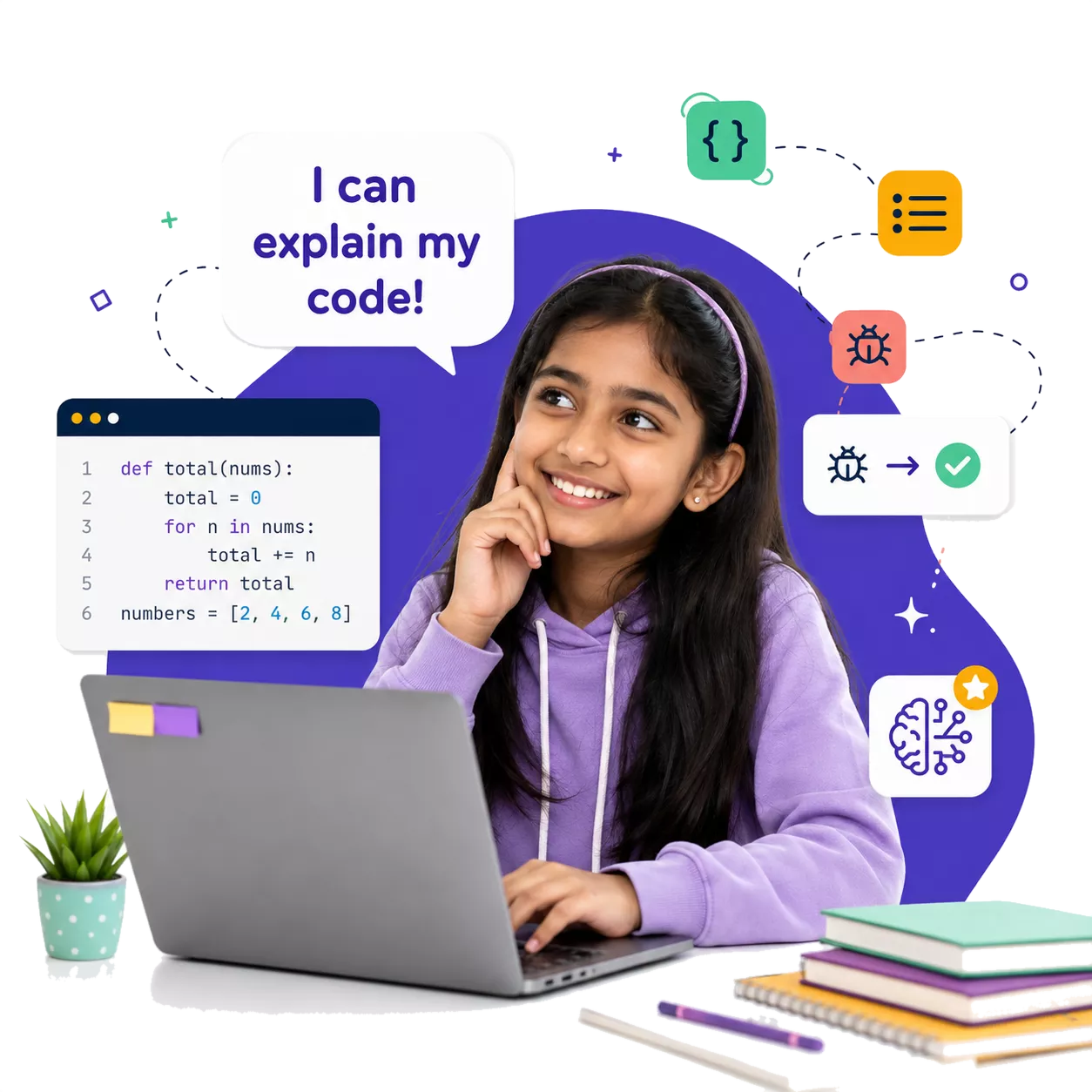
AI is introduced carefully as a supervised tool for ideas, assets, and explanations, never as a replacement for the child's thinking. If children cannot explain the code themselves, it does not count as their work.
THE LEARNING JOURNEY

From Blocks to Independent Python Projects

A 24-week journey from writing the first lines of Python to planning, building, reviewing, and presenting an original program.

Weeks 1–8

From Blocks to Python

Weeks 9–16

Data, Functions & Useful Programs

Weeks 17–19

Build, Review & Responsible AI

Weeks 20–24

The Capstone Project

What They Explore

The Six Powers.

1

Chop It (Decomposition)

Breaking a larger Python program into smaller jobs and organising them into clear functions.

Spot It (Pattern Recognition)

Recognising repeated logic and turning it into reusable code instead of writing the same instructions again.

2
3

Zoom Out (Abstraction)

Using well-named functions and data structures to manage complexity without thinking about every line at once.

Step It (Algorithmic Thinking)

Planning algorithms before coding and translating those plans into clear, working Python.

4
5

Fix It (Debugging)

Reading error messages, tracing where a problem begins, testing one change at a time, and identifying the real cause.

Judge It (Evaluation)

Reviewing code against clear criteria, comparing approaches, and explaining why one solution is better suited to the problem.

6
Parent Stories

Small Moments. Meaningful Progress.

What families notice when children begin thinking, building and explaining with confidence.

“She now treats mistakes like clues, not failures.”

Parent of a 7 year old

“He does not just show us his game. He explains how every part works.”

Parent of a 8 year old

“The small class helped her feel noticed, supported and brave enough to try.”

Parent of a 6 year old