This is where young coders begin thinking like programmers. Children move beyond simply making things work and learn to plan before they build, reason about logic, organise data, debug systematically, and compare different solutions.
At this age, children are ready to work with deeper programming ideas such as if/else logic, nested loops, variables, lists, custom blocks, parameters, and program states. But we still do not teach coding as memorising commands.
A new idea begins with something children can see, move, question, or test before it becomes code. More importantly, planning becomes part of the work. Children learn to sketch a solution, break it into parts, write the steps, then build.
When something breaks, mentors do not simply fix it. Children learn to narrow down the problem, form a theory, change one thing, test it, and explain what they discovered. By the end, the goal is not just “I made it work.” It is “I can explain why it works.”
A 24-week progression that takes children from deeper programming logic to planning, building, testing, and presenting an original project of their own.
Weeks 1–8
Logic, Loops & Data
If/Else Logic
Nested Loops
Counters & Variables
Randomness
Introduction to Lists
Step-by-Step Debugging
Weeks 9–16
Bigger Programs & First Web Pages
Building Bigger Programs
Custom Blocks
Program Planning
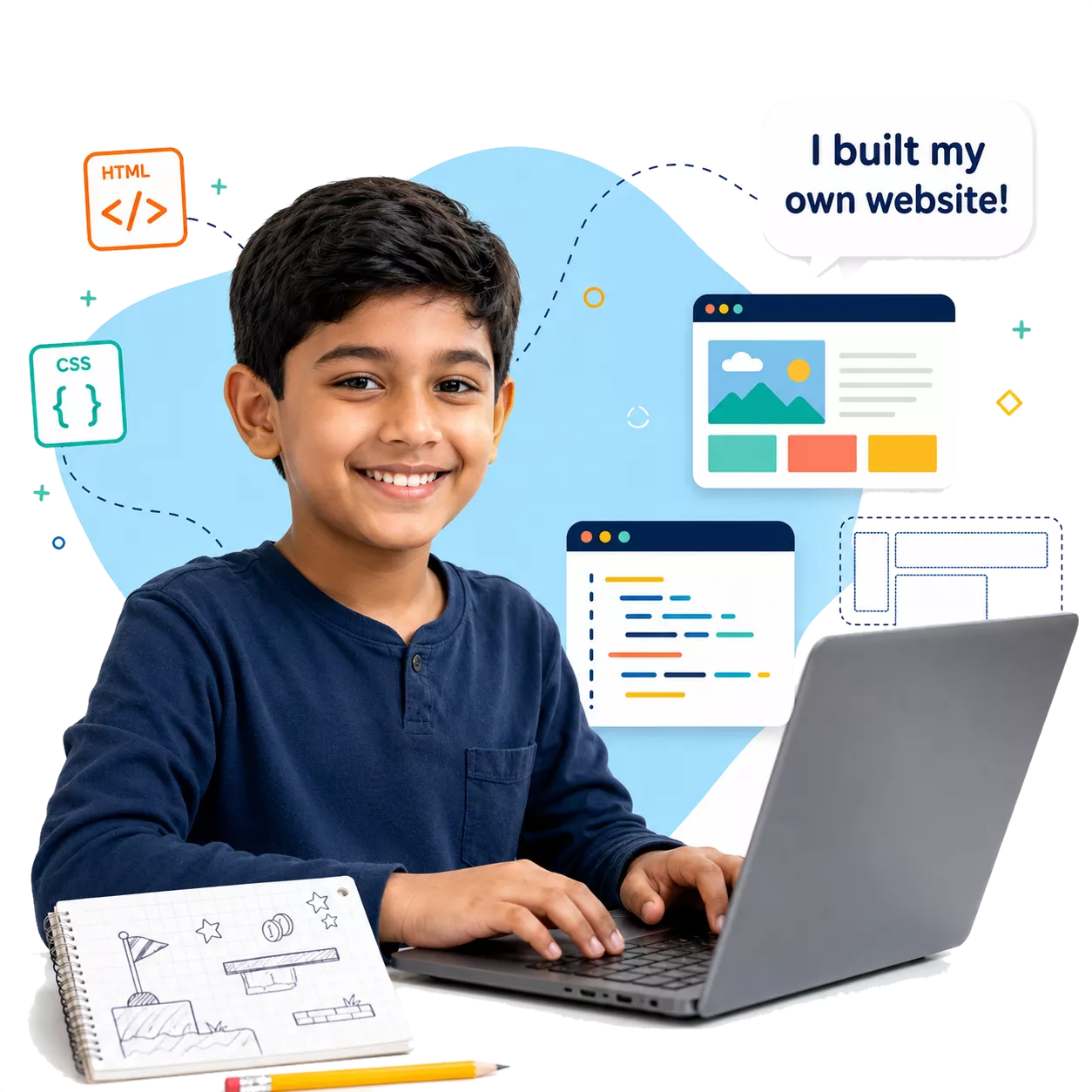
Introduction to HTML
Introduction to CSS
Building First Web Pages
Weeks 17–19
Design, Feedback & Digital Responsibility
Designing for an Audience
Testing & Improving Projects
Giving & Receiving Feedback
Digital Responsibility
Responsible AI Habits
Safe & Responsible Technology Use
Weeks 20–24
The Capstone Project
Independent Project Planning
Building an Original Project
Testing & Debugging
Improving & Refining Projects
Explaining Project Decisions
Project Presentation
What They Explore
The Six Powers.
1
Chop It (Decomposition)
Planning a project on paper and breaking a larger idea into manageable parts before building.
Spot It (Pattern Recognition)
Recognising repeated structures and using loops, reusable blocks, and patterns instead of rebuilding the same solution.
2
3
Zoom Out (Abstraction)
Turning repeated behaviour into a named custom block and focusing on what a part of the program does rather than every individual instruction.
Step It (Algorithmic Thinking)
Writing and testing an algorithm before coding, then turning that plan into a working program.
4
5
Fix It (Debugging)
Using a systematic process to narrow down a bug, form a hypothesis, change one thing, test it, and explain the actual cause.
Judge It (Evaluation)
Comparing different working solutions against clear criteria and explaining why one approach may be better for the problem or audience.
6
Parent Stories
Small Moments. Meaningful Progress.
What families notice when children begin thinking, building and explaining with confidence.
“She now treats mistakes like clues, not failures.”
Parent of a 7 year old
“He does not just show us his game. He explains how every part works.”
Parent of a 8 year old
“The small class helped her feel noticed, supported and brave enough to try.”
Parent of a 6 year old
“She now treats mistakes like clues, not failures.”
Parent of a 7 year old
“He does not just show us his game. He explains how every part works.”
Parent of a 8 year old
“The small class helped her feel noticed, supported and brave enough to try.”