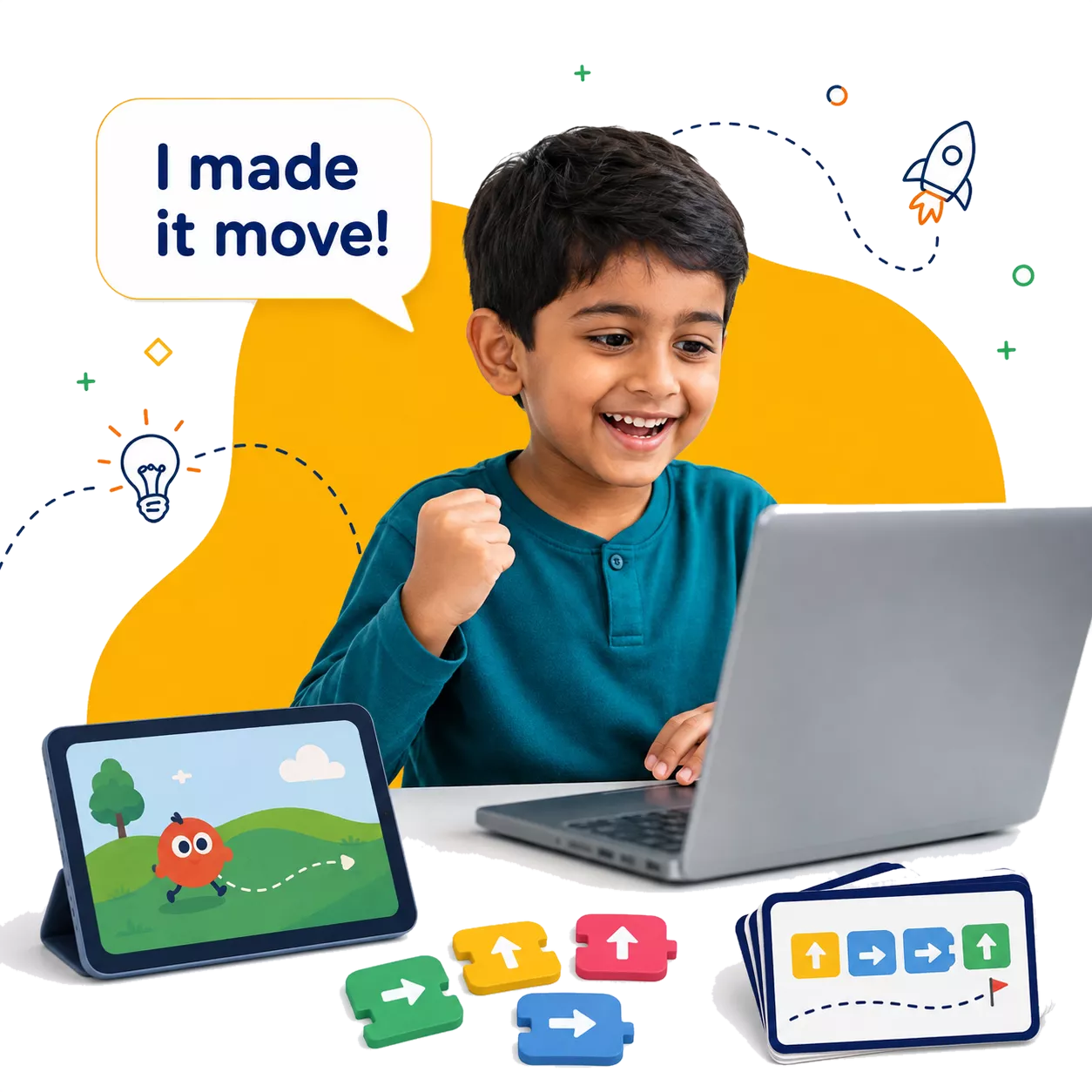
Give your child their first serious experience of creative technical work. In small groups, with skilled mentors, children build real, physical-first projects leaving every session with something that works, and something they can say about how they made it.
A 24-week progression that takes kids from foundational coding concepts to building, testing, and confidently presenting an original project of their own.
Weeks 1–8
Foundations & Sequence
Introduction to Coding
Sequences & Step-by-Step Instructions
Predicting Outcomes
Physical Algorithms
Simple Debugging
Independent Mini Projects
Weeks 9–16
Rules, Signals & Repetition
Simple Rules & Conditions
Events & Start Signals
Repetition & Patterns
Introduction to Loops
Characters, Sounds & Actions
Sharing & Explaining Projects
Weeks 17–19
Craft & Audience
Sorting & Grouping
Breaking Problems into Smaller Parts
Creative Design Choices
Characters, Colours & Sounds
Simple Decision-Making
Designing for an Audience
Weeks 20–24
The Capstone Project
Project Planning
Building an Original Project
Testing & Debugging
Improving a Project
Explaining How a Project Works
Project Presentation
The Little Coders Way
Abstract Ideas Need a Body First
At this age, abstraction such as loops and conditionals must be physical before it is symbolic. We do not teach rote syntax or passive screen consumption. Every new idea is introduced through games, cards, and floor grids before it ever appears on a tablet a loop is a dance move repeated four times before it is a block. Children learn how a machine follows instructions exactly, in order, and how to notice and fix it when something doesn't work.